
Mythical Origins Part III: Nazi Germany

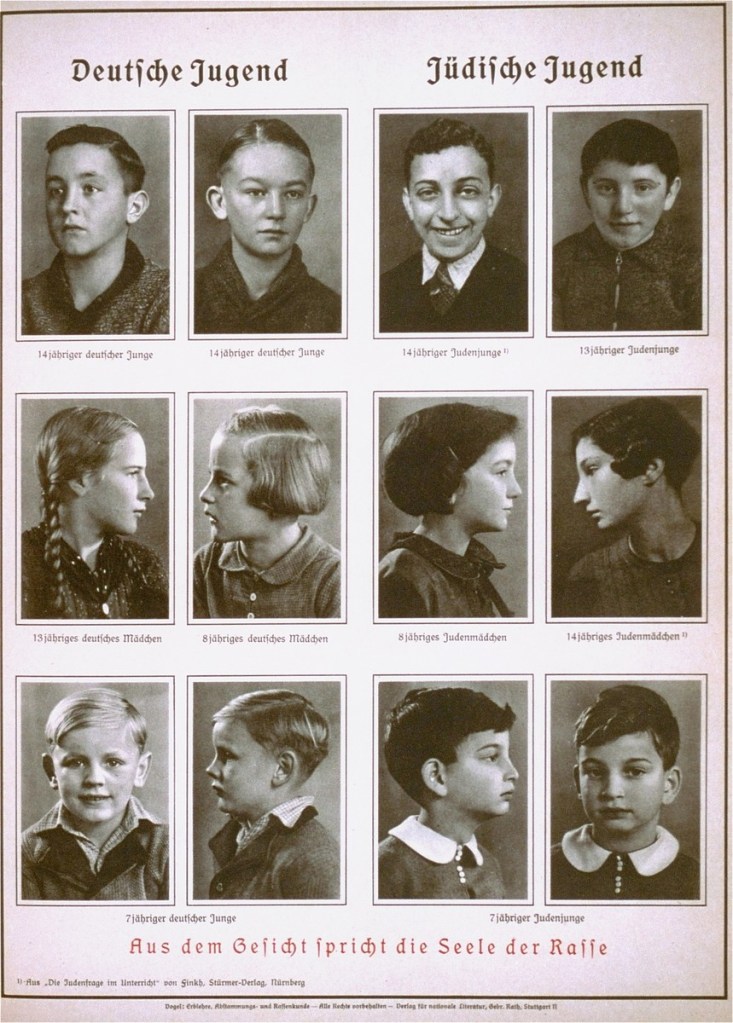
Nazi German poster that compared “Aryan” (left) and Jewish (right) children for racial classification. Nazi propaganda used both existing and fabricated myths to promote the idea of a master race. (United States Holocaust Memorial Museum)

Nazi Germany, was, in every sense, a totalitarian dictatorship. Through the whims of just a few powerful men, it caused and facilitated more destruction than perhaps any other state or institution that has ever existed in the history of the world. With absolute power in their hands, Adolf Hitler and his inner circle had complete control over anything that happened within Germany or the territories it later controlled. Any internal opposition to the ideas or actions of the Nazi Party or its leadership would quickly be snuffed out by cruel agencies such as the Gestapo, the Nazi secret police. The Nazi regime is rightfully remembered as the historical epitome tyranny and oppression; the antithesis of liberty and democracy. It is therefore surprising to learn that Hitler and his inner circle first came to power largely by legitimate means. That is, they were elected through free and fair elections or appointed by existing government officials as allowed by the constitution of the Weimar Republic. While Hitler eventually transformed Germany into the despotic nightmare that the world has come to despise, his unassuming rise to power reveals one important fact about the Nazi party: that the ideology that the party produced was not merely the insane machinations of a few corrupt politicians, but a complete set of social, moral, and political ideas that genuinely captured the hearts and minds of the German people.

Though there were a number of factors that allowed for the rise of the Nazis, one issue on the minds of many Germans was the standing of the German people in relation to the rest of the world. The humiliating result of the First World War and the economic hardship as result of the worldwide Great Depression left Germany in a weaker state than it had been in for decades. Therefore, the Nazis capitalized on the people’s desire for German strength, empowerment, and respect. This led to the creation of the myth of the Herrenrasse, the superior race of humans. This and other myths central to the Nazi party’s ideology were themselves derived from much older myths originating from the Nordic and Germanic cultures that predated the Nazis by centuries. Like the Yoruba myths in West Africa, these myths were modified or outright rewritten to further the political agenda of the Nazi party. More specifically, it upheld the notion that the peoples of Central and Northern Europe were inherently superior, and therefore justified the continued aggression of Nazi Germany, by claiming and maintaining Germany as the world’s dominant people.

Hitler, Goering, Himmler, Goebbels—all names typically associated as being the core of the Nazi party. But one name often less remembered by popular history belonged to man whom Hitler himself credited as being a spiritual co-founder to Nazism: Dietrich Eckart. Eckart was a political writer and poet from the Bavaria region of southern Germany, who was active in the earliest days of the Nazi party, helping create the underlying principles of the Nazi party, as well as the personality cult surrounding Adolf Hitler. A fervent anti-Semite, many of Eckart’s works featured furious ramblings about the growing influence of Jews in Europe, and the responsibility they held for the decline of Germany. He considered Jews as an outside, corrupting force that was weakening the German people, and saw Hitler as a messiah who would save them. However, there was a key problem in convincing the German people in Eckart’s vision. Germany, for most of its history, was not unified under one political or cultural entity. Eckart himself was born in the Kingdom of Bavaria, which was effectively its own country before it became a part of Germany. How could the German people unite against their Jewish enemy if they could hardly find unity among themselves? The key was through finding a common heritage in Nordic and Germanic folklore.

Eckart, alongside future prominent Nazi officials such as chief Nazi racial theorist Alfred Rosenburg, belonged to a occultist organization in Munich called the Thule Society, named after a legendary Northern European nation that appeared in Roman and Greek mythology. The society believed in a perfect, almost superhuman Aryan Teutonic race. They believed this race descended from the mythical land of Atlantis, and later migrated into Germany where they became the Germanic peoples we know today. The society claimed, however, that the race was in danger, and was being corrupted by races inferior to them, such as the Jews. Not did they believe that a cultural and genetic destruction of the master race was taking place, but also believed that it was actually part of a deliberate plot by the enemies of the Aryans to take power and remove the Aryans from their rightful place at the apex of human civilization. In the end it was actually the Thule Society that first sponsored the German Worker’s Party, which, under the direction of Hitler and his henchmen, would transform itself into the Nazi Party.

While the Nazi Party did adopt its own original mythology through Nazi-affiliated scholars such as Eckart or Rosenburg, it did incorporate elements of existing European mythology to strengthen its connection to its alleged Aryan heritage.

Helmet of the SS

One example of a Nazi attempt to directly tie itself to Northern European tradition can be seen in the emblem of SS, the Nazi paramilitary group that was under the direct control of the Nazi Party. The emblem contains two Germanic sig runes, which both mean “victory”. The SS emblem is now one of the most enduring symbols of Nazi Germany.

Today, mythology, whether from ancient European traditions or Nazi racial theory, continue to be part of the far-right movements of the present. Symbols such as the Celtic Cross and Triskele are used by certain white supremacist groups, which, by using these symbols, attempt to call back to a sense of common European heritage and pride. As tragic as it is, there can be no denying that the traditions and symbols of several Northern and Central European cultures has forever been associated with the actions of a few individuals. The complex tale of the development of Nazi ideology provides a sobering tale for what it means to embrace or butcher the truth, and how easily the line between the two can be blurred.

Mythical Origins Part II: Yoruba

Palace of the Oyo Olofin. The Oyo Empire used alternative versions of traditional Yoruba mythology to maintain power (Wikimedia Commons)

While the mythical origins of any people invariably affect how that people views the world, sometimes the myths that are central to a national, cultural, or ethnic identity and can be warped, distorted, or otherwise interpreted for explicit purpose of following a political agenda. In this iteration of the Mythical Origins series, as well as the next, we will examine examples of this phenomenon.

The Yoruba people are an ethnic group that originates from modern-day Nigeria, Togo, and Benin, which collectively comprise a cultural region known as Yorubaland. While modern day Yoruba often identify with their shared cultural label, there are a variety of sub-groups that the Yoruba people are made of. In fact, the name “Yoruba” was not used to describe the people collectively until the 19th century. So, like many myths that belong to a broader culture, the origin myth of Yoruba has variations within each of the group’s own subgroups that together create a generally unified narrative that can be told as one story.

The Yoruba kingdom is said to be founded in the city of Ile Ife (or simply, Ife). Some versions of the myth describe the first king, Oduduwa, as being born in the city of Ife itself, with all subsequent generations of humans spreading out into the world after. However, the more commonly accepted version has Oduduwa migrating from the city of Mecca, the holy city of Islam, into Ife, from which he started his empire. Regardless of which version of the myth is accepted, the myth centers around Oduduwa as the founder and first leader of the Yoruba people. Sometime after Oduduwa’s birth or arrival in Ife, he ruled the city as king. After his death, Oduduwa’s sons dispersed all throughout Yorubaland to found their own kingdoms. Using their lineage from Oduduwa as a justification of their rule, each of his sons are said to have founded his own dynasty.

While this origin of the Yoruba people may seem far more historically plausible than more supernatural myths, such as Japan’s, it’s validity has been just as difficult to prove, due to lack to historical evidence and consistency. The most immediate descendants of Oduduwa, alongside Oduduwa himself, were effectively worshipped as gods, so it is unclear whether or not they were real people who were divinized, or supernatural deities who were humanized in myth. As with every myth, historical validity seldom affects real-world impact; a claim to being a descendent of Oduduwa, however outlandish or even fabricated as it may be, was key to guaranteeing one’s right to rule in the eyes of the Yoruba people. As a result, Yoruba rulers have never hesitated to use a claimed relation to Oduduwa as a way to secure power, strengthen the identity of a Yoruba sub-kingdom, or otherwise ensure their social or political standing among other Yoruba.

One well-studied example of Yoruba mythology being used for political influence is found in the kingdom of Oyo, which despite its mysterious origins, became among the most powerful and respected Yoruba kingdoms of the 17th and 18th centuries. Most traditions assign Oranyan, founder of the Oyo Empire, to be the youngest of Oduduwa’s sons. This assignment may reflect a historically weaker standing of the Oyo Empire, as the descendants of the youngest son would naturally feel a sense of inferiority to those who descended from higher ranked branches of Oduduwa’s family tree. However, as the Oyo Empire gradually became more influential, alternative stories for Oranyan’s origin began to appear. Some alternative myths began to claim that Oranyan was actually Oduduwa’s most favored son, and bestowed upon him all of the lands of Yoruba, or even that Oranyan actually created Yorubaland itself. Indeed, these alternative myths were no accident; the Olofin, ruler of the Oyo, employed a group of historians in his own personal court, who were responsible for making these myths official and more widely accepted as truth in the eyes of the people. Gradually, this new mythical tradition became widely accepted, and it took deep, investigative work by modern historians to separate traditional Yoruba history from the one propagated by the groups in power.

From The heritage of Oduduwa: traditional history and political propaganda among the Yoruba, The Journal of African History, R.C.C. Law (1973):

This problem, that of reconciling the actual extent of Oyo power with the extent of the empire which the [Olafin] should have inherited from Oduduwa, seems to have generated a series of supplementary traditions, tracing the totally fictitious ‘decline’ of Oyo power from its alleged zenith under Oranyan.

As Africa began its dark era of European colonization, the importance of propaganda such those created by the Oyo kings faded from relevance as local monarchs were replaced by imperial governors. However, as the decolonization period began decades later, the use of propaganda, specifically those stemming from inflammatory (though perhaps entirely true) interpretations of history, began an effective tool in establishing nationalist identities in states once under European rule. These identities would eventually lead to conflicts such as the Rhodesian Bush War.

It is often said that history is written by the victors, and the success that the Oyo kings had in creating a more favorable version of history does little to disprove that claim. The alteration of Yoruba mythology demonstrates the importance of examining bias in historical documents, and the work historians do to use primary sources not as an objective account of events, but as a tool for finding the truth, whether or not the source directly supports that truth.

Mythical Origins Part I: Japan

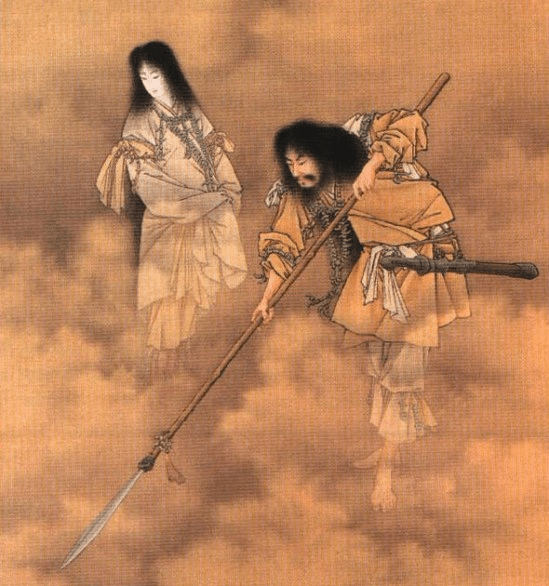
Izanami stands as Izanagi dips the Amenonuhoko into the sea (MFA Boston)

“Myths are things which never happened, but always are.”

Salutius, 4th century CE

Every civilization in the history of the Earth has a story of who they are, and how they got there. While few of these could ever be verified by historical or archeological fact, even the most unlikely of origin stories can impact a society just as much, or even more, than if the story was certain to be true. This series will provide a brief outline of the mythical origins of a handful of civilizations, and draw historical connections between those myths and the peoples it served, or continues to serve, as a foundation to. As a whole, the series will attempt to highlight that in history, myth and fact can go hand-in-hand, and that the line between them is not always clear, nor relevant in shaping humanity.

In the beginning, there was only chaos; the world a formless disarray of nothing and everything at the same time. From the disorder emerged a dichotomy between two opposing ideas: Heaven and Earth, with the divide between the two being apparent in all worldly and spiritual things.

Japan’s creation myth is similar to others such as the Ancient Greeks or Hawaiians, who generally believe that the universe was created from chaos; that the things that made up the universe were initially or always existent, though disordered, and were then reorganized into universe we see today. Creation from chaos myths are distinct from other categories of creation myths, such as creatio ex nihlio (Latin for “creation from nothing”): the belief in a single intelligent being creating the universe from nothingness.

Takamagahara, the abode of the heavenly gods, was the first thing created from the chaos. Emerging from the primordial oil and now living in Takamagahara were the three original creation gods: Amenominakanushi, Takamimusubi, and Kamimusubi. Seven generations of deities were born from these original three, with the final generation consisting only of brother Izanagi and sister Izanami. The two were gifted were a sacred jeweled naginata (a traditional Japanese spear) at birth. The siblings, now standing on the bridge between Heaven and Earth, stir the sea with their naginata, creating the Earth’s first islands from the droplets that fell from the spear’s tip, and finally descending from Heaven to live on them. Before long the two realize their anatomical differences, and organize a marriage ceremony around the pillar of Heaven. Their first set of offspring are severely deformed, which they determine, after some discussion with their dead ancestors, is a result of Izanami speaking first during the ceremony instead of Izanagi. The couple redo the ceremony, this time successfully abiding by their respective roles.

The naginata, central to Japan’s creation myth, is also central to the nation’s military history. A versatile weapon—something between a sword and a lance—was used by everyone from samurai to warrior monks. Meanwhile, the pillar of Heaven, around which the wedding takes place, is replicated with the central pillars common in buildings constructed during the Yayoi period of Japan (300 BCE–300 CE). With regards to Izanagi and Izanami’s relation to each other, it is important to note that there is a level of ambiguity within certain Japanese words for “wife” and “little sister”, so scholars continue debate whether or not they can be considered related by blood. Lastly, the story about Izanami’s botched role in the ceremony reflects Japan’s traditional gender roles and historically conservative attitude towards women, as well as the Confucian philosophy on gender roles which influenced virtually all of East Asia and beyond.

The renewed union between Izanagi and Izanami results in a new set of offspring, which take multiple forms. These include new islands, geographical features such as forests and mountains, and even more gods. Finally, Izanami dies in childbirth after she gives birth to her most volatile creation, fire. A complicated saga ensues after her death, which actually results in permanent rift between couple. Izanami, now a resident of the underworld, threatens to condemn thousands of mortals to death unless her husband backs off, while Izanagi promises to do the opposite by creating an even greater number of births, thus creating the cycle of birth and death. Meanwhile, the original couple themselves aren’t the only ones having problems with each other; so are the many gods whom they created. After Susano’o, the storm god, gets into a quarrel with his sister, the sun goddess Amaterasu, the latter locks herself into a cave, plunging the world into darkness.

The new islands described as being created by Izanagi and Izanami align well with the islands of Honshu, Kyushu, and the other major islands that make up Japan. Amaterasu locking herself in the cave likely corresponds with a real life natural disaster, such as an eclipse, or perhaps the infamous year 536 CE, in which most of the world, not just Japan, experienced massive crop failure probably due to a volcanic eruption which created an ash cloud that blotted out the sun.

If all of this sounds confusing and disconnected, that’s because it is. Although Japan is considered a culturally homogenous country, that was not always the case. Its ancient peoples consisted of small independent tribes and chiefdoms, whose various myths and legends eventually culminated in an only somewhat cohesive narrative of Japanese mythology. It was not until long after these myths were created, well into the first millennium CE, that surviving records of these myths are found. The many myths that can together be considered the creation myth of Japan are a mostly a compilation of the many disputes, affairs, and fights between the gods. Many of these myths would follow a pattern such as this: a few gods get into trouble with one another, they start fighting, and something important is ultimately created as an unintended result of the fighting.

Out of the mishmash that is Japanese mythology, the two most direct and tangible legacies of the Japanese creation myth are the Shinto religion and the alleged origin of the Japanese imperial family. Shinto is considered the indigenous religion of Japan, and has existed in some form since even before the Common Era. Blending elements of Japanese folk traditions (including its mythology) and Zen Buddhism, the religion is an important symbol of Japan, influencing many of the nation’s most iconic traditions, historical events, and architecture. The semi-mythical beginning of the Japanese imperial family can also be traced to the country’s founding myths. According to legend, the aforementioned sun goddess Amaterasu—herself a descendent of Izanagi, Izanami and the original three gods—had an extensive and documented lineage of her own. Five generations below Amaterasu lies her great-great-great-grandson, Jinmu, who is considered to be the first emperor of Japan. 126 generations later, the family tree arrives at Naruhito who, although stripped of all but ceremonial powers, is the current emperor of Japan. Thus, if one were to directly trace the lineage of Naruhito as far up as the records allow, Naruhito can be considered a direct descendant of the original heavenly gods. Many readers will no doubt be familiar with fanatic acts, such as piloting a kamikaze airplane, being done in the name of Japanese emperor. These could be paralleled to acts of religious fanaticism, since both consider their actions as vindicated by the divine.

Japan is a unique nation that was formed from unique circumstances. Its mythical origin reflects the values and customs that has transformed the country from a few tribes inhabiting a handful of islands to an enduring economic and cultural power that has influenced the entire world.