
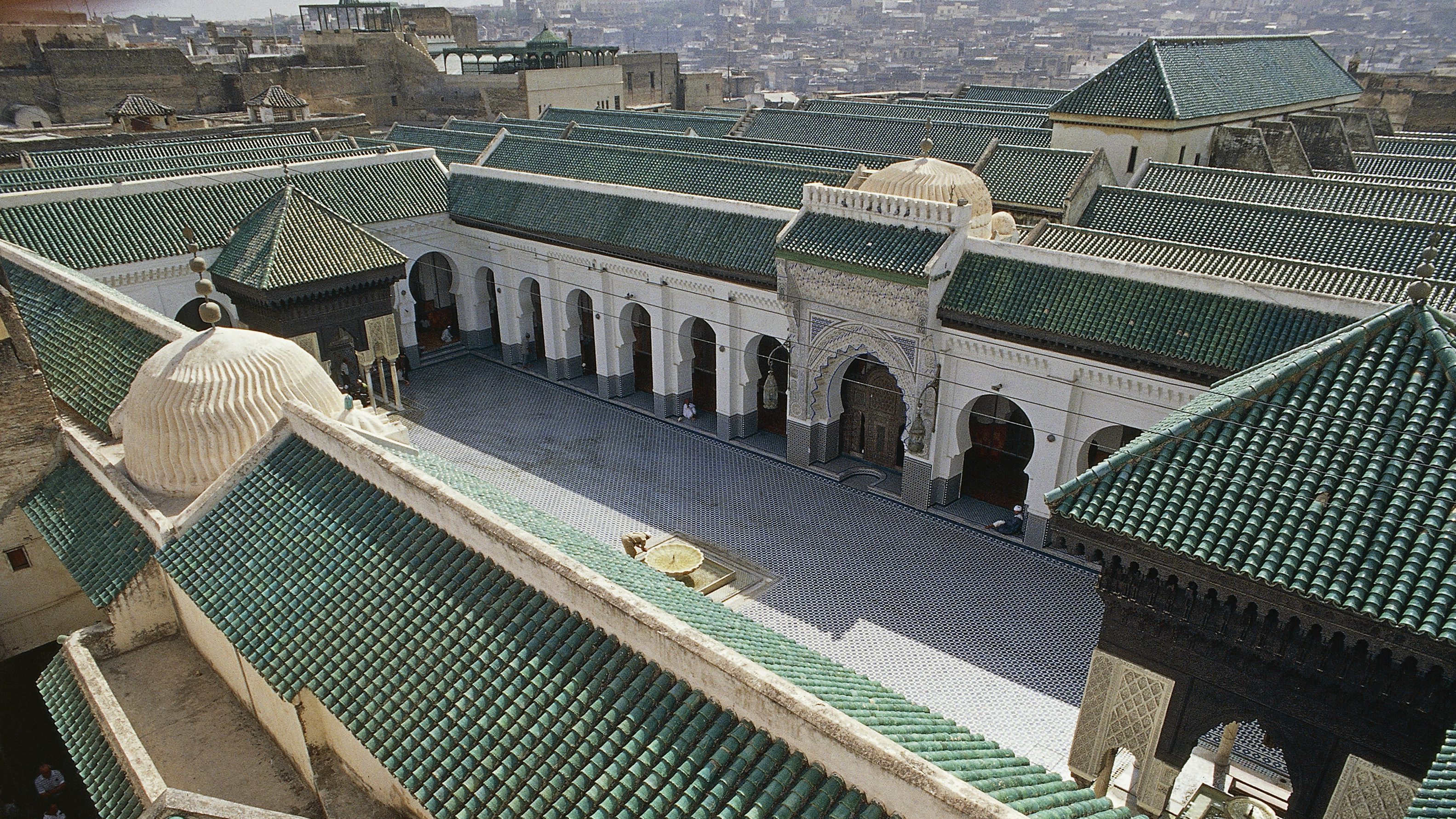
Places of higher learning have long been the backbone of history’s most prosperous civilizations. From the Platonic Academy of Athens to England’s University of Oxford, these centers of learning serve not only as a meeting place of different ideas and great thinkers, but as enduring cultural icons for the people they serve. But one university, considered to be the oldest of them all, comes from a seemingly unlikely place, and an even more unlikely person. Nestled in the old walled district of Fes, Morocco, the University of al-Qarawiyyin, in addition to holding Earth’s oldest known library, is considered by many to be longest continuously operated place of higher learning the world. Though the exact period when it began teaching is uncertain, it is generally presumed that instruction began shortly or immediately after its founding as a mosque in 859 CE. Its founder, an ambitious yet benevolent heiress named Fatime al-Fihri, created al-Qarawiyyin as a religious and educational meeting place for Fes’ diverse populace. Today, the university is still an iconic landmark of the former Moroccan capital, and is one of the nation’s most respected academic institutions.
Though few details of her early life are documented, Fatime al-Fihri is considered to have been born at the beginning of the 9th century CE in Tunisia. Her father, Muhammed al-Fihri, was a successful merchant who left a considerable fortune to Fatima and her sister, Maryam. Before his passing, however, the Muhammed al-Fihri and his family moved from their village in Tunisia to the city of Fes in search of a new life. Fes was a bustling city that was a blend of North African, Arab, and European cultures, due to migration being fairly common at the time. As a result, both of the al-Fihri sisters grew up in an environment surrounded with people with vastly differing origins. As the sisters grew older, both realized that the rapid flow of migrants, especially those coming from Spain, were beginning to crowd many of Fes’ mosques. As a result, both used a significant share of the wealth inherited from their father to found mosques that would be open to people of all backgrounds. While Maryam’s al-Andalusiyyin Mosque, also called the Mosque of the Andalusians, is known throughout Fes, Fatime’s al-Qarawiyyin is one the premier sites in all of North Africa. Motivated to create a place of learning in addition to its function as a place of worship, Fatime was thoroughly involved in al-Qarawiyyin’s entire construction process. And, according to some sources, she fasted throughout the 18 year build, further proving her dedication to the project.
Finally, in 859, al-Qarawiyyin opened its doors to the world. Though initially similar to many large mosques at the time, where educational functions were included to supplement the building’s main religious purposes, al-Qarawiyyin soon became a fully fledged educational institution. As the centuries passed, the university’s curriculum broadened, peaking around the 13th and 14th centuries. In addition to its specialization in religious studies and Islamic law, the university expanded its scholarly work into astronomy, mathematics, philosophy, and geography. This period, during which Morocco was under the rule of the Marinid Sultanate, was also considered to be near the height of the Islamic Golden Age. The Golden Age, a period of rapid cultural, scientific, and intellectual advancement, was far different from the European Dark Ages often associated with the period in Western history.
Though the Islamic Golden Age applied to the many nations and empires throughout the Muslim world, the University at al-Qarawiyyin is no doubt a large part of the legacy left behind by this bright period of human advancement. Its alumni reflect the success of both the Muslim civilizations at the time, and Fatime’s original goal of making it a place of true cultural and intellectual exchange. Early forms of algebra were first developed at al-Qarawiyyin, and some even claim that Pope Sylvester II first introduced Arabic numerals to Europe after a brief visit the university. Maimonides, who attended the university some time in the 12th century, went on to become of the most renowned Jewish philosophers and Torah scholars of his time. Ibn Khaldun, one of the most accomplished social scientists of the Middle Ages, is one of many prominent Muslim scholars who studied at the university. His careering spanning the latter half of the 14th century, Khaldun made tremendous strides in political science, history, and economics, and continues to gain the recognition of scholars across the globe today. Finally, famed explorer, merchant, and diplomat Leo Africanus grew up in Fes and studied at al-Qarawiyyin as a young man in the early 16th century. Following his time at the university, his many adventures (which included being sold into slavery and later baptized by the Pope himself) culminated in the production and widespread printing of Description of Africa, which remained the most comprehensive work on the subject until the 19th century.
As Fes, Morocco, and the entire Islamic world began to decline from its former glory, al-Qarawiyyin began to show its age. Its collections were greatly reduced, as was the breadth of its teachings. Subjects such as astronomy and medicine were struck down entirely. As Morocco became under French control in 1912, the university continued to suffer, with many of the country’s elite instead being sent to Western-style colleges either elsewhere in Morocco, or to France itself. However, after regaining independence, the Moroccan government added al-Qarawiyyin to its state university system in 1963, giving it adequate support to continue operation as a multi-disciplinary university.
Be it through students walking through the university’s ornately decorated tile hallways, or through distant passersby admiring the mosque’s silhouette on the Fes skyline, the legacy of Fatime al-Fihri lives one through her commitment to advance humanity through connection and learning.
 History for Empathy