
Rani of Jhansi

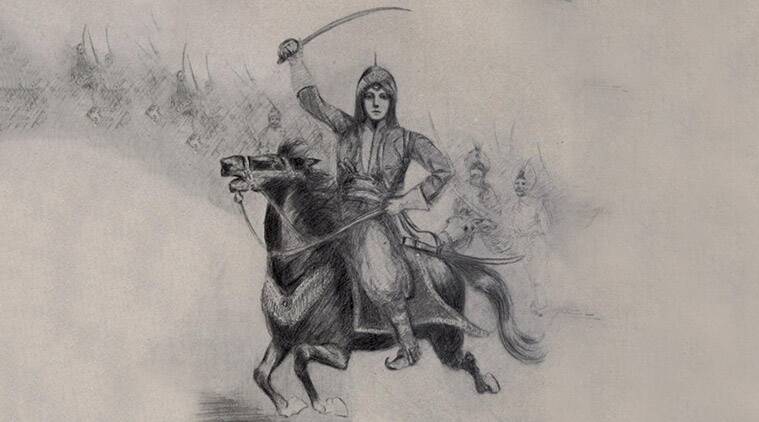
A 1901 British sketch of Rani, described as India’s Joan of Arc (Indian Express)

A near-mythical figure in India, Rani of Jhansi is a figure closely associated with the struggle for British independence, and yet she is seldom remembered in the West, beyond perhaps a footnote in the centuries-long occupation of the Indian subcontinent. From her bold defiance towards her country’s traditional gender norms, to her martyrdom at the hands of the British colonizers, her story is one which all draw inspiration can from.

Manikarnika Tambe was born on November 19, 1828, in the city of Varanasi in the Benares State of Northern India. At the time of her upbringing, much of the Indian subcontinent under the control of the British East India Company (EIC), either through direct control, or through the suzerainty of local autonomous kingdoms or states. With a series of trading forts along India’s coastal cities, the EIC began its presence in India as one of the several European trading corporations interested in lucrative commerce with the dominant Mughal Empire. But due to internal weakness within their opponent’s ranks, and the adoption of a clever “divide and conquer” strategy of winning over local lords, the EIC was able to expand its control of India slowly over the course of a century, defeating the otherwise militarily and even technologically superior Mughal Empire. Thus, by the time Manikarnika was growing into a young woman, the banner of the “Company Raj” (the name given to the EIC’s territory) flew over much of India.

Born to an advisor for a local ruler, the status of the Tambe family allowed Manikarnika to receive an education, and have firsthand exposure to the type of strong leader she would aspire to be. In addition to reading and writing, Manikarnika learned marksmanship, horseback riding, and other arts traditionally taught to young men. At the age of 14, she was married to Gangadhar Rao Newalkar, the ruler of the independent princely state of Jhansi. Following the Indian female tradition of renaming oneself after marriage, the new bride was now named Rani Lakshimbai. Despite being the official queen consort of Jhansi, Rani was far from the spitting image of femininity during her time. She did not wear a veil over her face, nor did she shy away from public interactions with commoners and officials alike. Rani’s reign, however, was to be short lived, as the issue of succession became salient to her, and others. Under a policy mandated by the EIC called the Doctrine of Lapse, any state without a clear and legitimate heir was to be absorbed into British control. Unfortunately for Rani, she and her husband were unable to produce and heir, and as Rao’s health worsened, the couple adopted a five year old son to serve as heir to the throne. After the death of Rao in 1853, however, Lord Dalhousie, the incumbent British Governor-General of India, rejected the legitimacy of the new heir, and annexed Jhansi into EIC territory anyway. A shocked and betrayed Rani was removed from the Jhansi royal palace, given pension, and was expected to live the rest of her life in relative obscurity.

Rani’s furor and desire for justice rendered the prospect of inaction impossible, and luckily for her, such sentiments were widespread throughout India, especially in the North. British-imposed social reforms, harsh taxes, and an overall opposition to the presence of an colonizing foreign power, all helped ignite the Indian Rebellion of 1857, the largest of its kind since British hegemony began. Rebelling factions included Mughal remanants, mutineers from the EIC’s armies, and the armies of various states, kingdoms, or rulers, including Rani’s own. Alongside the EIC, several jurisdictions, such as Bombay, Madras, and Bengal, provided support against the rebels, while many others remained neutral. Regardless, Rani was determined to restore the rightful ruler of Jhansi to his throne. As fighting raged throughout the subcontinent, and mutineers massacred the British garrison in Jhansi, Rani reassumed control of her state in the summer of 1857, with the intention of holding it until a deal could be made with the British. But when General Hugh Rose and his forces arrived in March 1858, accounts claim that Rani had a change of heart, and refused to surrender the Jhansi fortress to Rose. A massive bombardment and siege ensued, followed by brutal street fighting. While Jhansi troops, led and inspired by their queen, fought valiantly, Rose eventually won the day.

From Alisha Haridasani Gupta of the New York Times:

As the town burned, the queen escaped on horseback with her son, Damodar, tied to her back. Historians have not reached a consensus on how she managed to pull this off. Some contend that her closest aide, Jhalkaribai, disguised herself as the queen to distract the British and buy time for her to get away.

In the end, the British took the town, leaving 3,000 to 5,000 people dead, and hoisted the British flag atop the palace.

After fleeing the Jhansi fort, Rani met with other rebel leaders at the town of Kalpi, where another clash with British forces would take place. A defeat there forced Rani and her allies to flee regroup in nearby Gwalior, where another army would be raised to face the British once more. In what would become one of the final acts of the rebellion, Rani’s forces engaged with British cavalry in June 1858, with Rani herself leading the charge. The force was defeated, with Rani herself being mortally wounded in combat. According to legend, she was leading a charge while dressed in male military garb, when she was struck by enemy fire. Hugh Rose, her longtime military adversary, commented that “The Indian Mutiny had produced but one man, and that man was a woman.” Per Rose’s personal account, Rani was given a burial with full honors. Not long after the defeat at Gwalior and Rani’s death, the rebellion was quelled, and British rule over India would continue for another century under Crown rule, rather than under the EIC.

Though she was unable to secure all of her aims, Rani of Jhansi’s legacy is one of defiance, both in the face of a great colonial power, and of a stringently patriarchal society. Besides being immortalized in Indian history, she has been the inspiration for countless of films, novels, and songs. Curiously enough, she is also the namesake of the Rani of Jhansi Regiment, an all-female guerilla force raised by Indian nationalists during WW2 to aid in the Axis fight against the British Raj. As present-day news headlines discuss the controversy of British colonialism, as well as the injustices of the Indian patriarchy, Rani of Jhansi is a captivating figure that may yet serve as a symbol for a new India.
The Rhodesian Bush War: Causes and Legacy

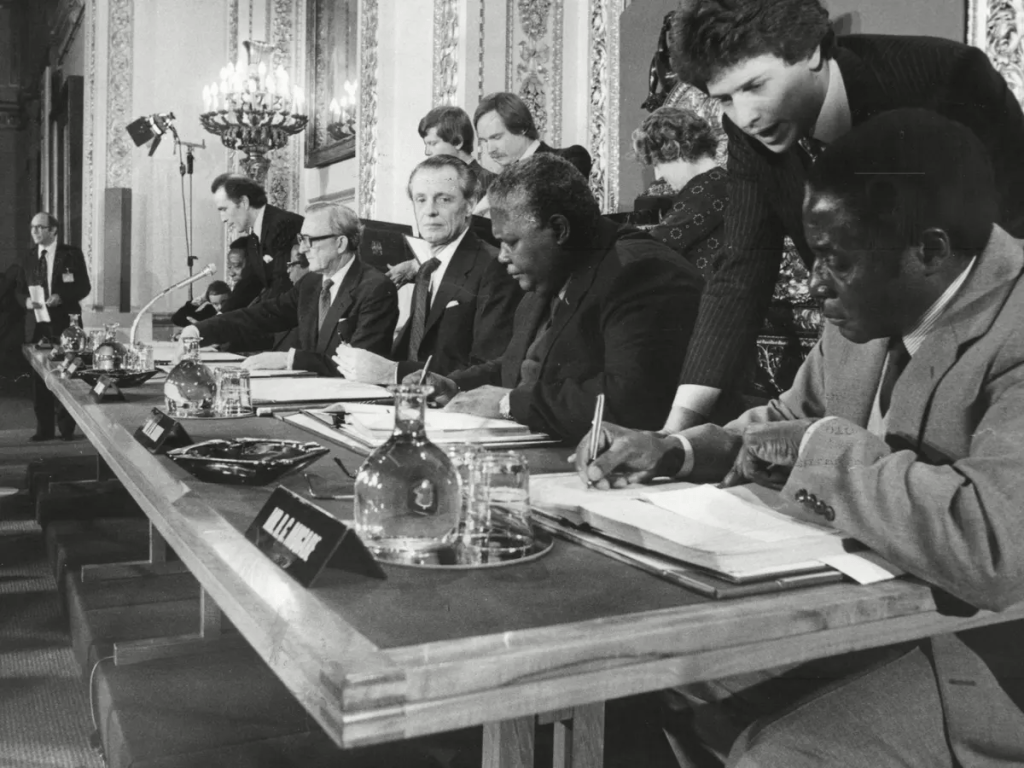
Key officials agree to the terms of the Lancaster House Agreement, the peace agreement that would lead to the full independence of Zimbabwe (The Guardian)

By the midpoint of the 20th century, the old colonial empires of Europe were beginning to come apart. The aftermath of the Second World War had ushered in a new era of peace, and created a growing distaste towards imperialism and nationalism as a whole. The part of the world most affected by centuries of colonialism was the continent of Africa, which, with few exceptions, was at one point the territory of one European nation or another. Africa’s transition into its post-colonial era is one full of triumph and tragedy, and is a process that arguable continues to this day. Perhaps the best known story from post-colonial Africa is that of South Africa, whose peaceful transition from apartheid-ridden colonial state into a (somewhat) fair and equal democracy inspired much of the world. However, today’s story will revolve around its neighbor to the north, the former British colony of Rhodesia, and the country it is today known as: Zimbabwe.

Though the lands that eventually became Rhodesia/Zimbabwe were occupied by a variety of peoples, it was primarily ruled by the Ndebele Kingdom, a breakaway tribe from the Zulu people to the south. The Ndebele were founded by Mzilikazi, himself a Zulu general under the famed King Shaka Zulu. The Ndebele would soon grow very powerful, and by the time European’s arrive at their door, they ruled the many tribes of Zimbabwe under a tribute system, including the Shona people who were previously the dominant force in the region. The divisions between the Shona and the Ndebele would continue well after the latter came into power in the mid-19th century. In 1888, after several years of British presence in the area, the British South Africa Company (BSAC) under the cunning, imperialist, white supremacist tycoon Cecil Rhodes began its rule over Zimbabwe. Mzilikazi’s son and successor, King Lobengula, agreed to a deal with Rhodes that would concede mining rights to BSAC. Rhodes subsequently used the concession to obtain a royal charter from the British Crown, and solidify the region as a British colony. The new territory owned by BSAC was named Rhodesia, whose namesake was, not surprisingly, Cecil Rhodes himself. White settlers soon flooded into Rhodesia, while its native people, Shona and Ndebele alike, were forced onto “tribal trust areas”, which filled a similar role as North American Indian Reservations. Treated as second class citizens in their own homes, the tensions between black African and white British factions is a common theme in many former European colonies on the continent, and was certainly the case in Rhodesia.

In 1923, the colony, now called Southern Rhodesia to differentiate it from the newly created Northern Rhodesia (now Zambia), officially became a self-governing colony of the British Empire, making the colony effectively independent as state, but still technically under British rule. Following the Second World War, the British government (in accordance with its decolonization policy) pressured Southern Rhodesia to end its minority rule of the country, and expand suffrage to its black African population. The colony was ruled entirely by its 80,000 whites, while its 2.5 million blacks still lived essentially as colonial assets. Not wanting to give up its control domination over the country, the white leadership of Rhodesia (switching back to its old name since Northern Rhodesia had already become Zambia) declared independence; a shocking move that was technically the first of its kind since the American Revolution. The new nation of Rhodesia, under Prime Minister Ian Smith, was now totally independent, though it did not receive any real international recognition. Rhodesia received harsh economic sanctions and condemnations not just from the British, but from the entire international community.

In 1964, shortly before Rhodesia’s Universal Declaration of Independence (UDI), the conflict now known as the Rhodesian Bush War began with a minor skirmish involving Rhodesian forces and one of the two emerging, Marxist, African nationalist groups. Formerly one entity, these two disparate parties were the Zimbabwe African People’s Union (ZAPU; its military wing named ZIRPA), and its breakaway group the Zimbabwe African National Union (ZANU; its military wing named ZANLA). The generations-long division between the Ndebele and Shona peoples was key to the split, as the two ethnic groups controlled ZIRPA and ZANLA, respectively. Throughout the war, ZIRPA and ZANLA would occasionally fight each other to gain better regional control. Opposite both of these factions was the Rhodesian Security Forces, a well equipped, professional army that had considerable air power, its own SAS special forces unit, while consisting of both white and black units. ZIRPA and ZANLA, having both being expelled out the country and into Zambia, conducted the first phase of the war (1964-1972) through a number of battles through and along the Zambian border. The Rhodesians thoroughly defeated the rebels in this first phase, even becoming confident enough to release rebel leaders such as Robert Mugabe, who they deemed to no longer be a threat.

However, as the Rhodesians were celebrating their apparent victory, both the ZIRPA and the ZANLA weren’t just licking their wounds, but were also gearing up for the second phase. Due to the involvement of communist and non-communist factions, Cold War politics inevitably found their way into the conflict. United States covertly supported Rhodesia due to the Rhodesian Front’s strong anticommunist sentiments, while South Africa provided ground forces to fight alongside them. But more importantly, the ZIRPA was strongly backed by the Soviet Union, while the ZANLA received support from the People’s Republic of China. The advisors and resources provided by their strong allies allowed the insurgents a tremendous advantage coming into the second phase (1972-1979). ZANLA’s relocation to Mozambique also meant that the Rhodesians also needed to fight along the Mozambican as well as the Zambian, further worsening the situation for Ian Smith’s government. As South Africa pulled out the conflict, and more insurgents entered the country, the situation for Rhodesia became desperate, with the Rhodesian Security Forces even resorting to using deadly chemical and biological weapons. In soon became clear that white minority rule was no longer possible, and a gradual political transition was attempted, which led to the election of the first black prime minister and president of a newly named, but short-lived state, Zimbabwe-Rhodesia. But for the warring ZANU and ZAPU, it was still not enough, and fighting continued until the Lancaster House Agreement in December 1979. The agreement, brokered by the British government under the newly incumbent Prime Minister Margaret Thatcher, granted Zimbabwe full and sovereign independence, while also allowing the belligerent ZANU and ZAPU parties to hold office. After a decade and a half of brutal conflict, Zimbabwe was finally an independent nation.

In 1980, ZANU leader Robert Mugabe was elected Prime Minster, and despite his popularity surrounding his anti-imperialist heroics, the election essentially began Mugabe’s 37 year rule as a brutal and corrupt despot. While the story of post-war Zimbabwe and Mugabe’s dictatorship is all too common among unstable African nations affected by colonialism, it is perhaps Rhodesia itself that has the most interesting legacy from the whole ordeal. Unlike South Africa, which peacefully transitioned from its white minority rule into a liberal democracy, the racist sentiments and overall brutality that caused its civil war still follow Rhodesia long after its dissolution. In the last few years, an odd nostalgia for Rhodesia has appeared it certain alt-right and white supremacist communities, especially in the United States. Dylann Roof, the perpetrator of the racially motivated 2015 Charleston church shooting, wrote his hateful, violent manifesto on a website called The Last Rhodesian, while a picture surfaced of him wearing a jacket with the Rhodesian Flag. Meanwhile, certain social media communities celebrate the existence of Rhodesia, with some claiming that Rhodesia was better off before its white rule was eliminated. As strange as Rhodesia’s modern legacy seems to be, there can be no doubt that European colonialism as whole, and the countless movements that resulted as a consequence of it have shaped the social fabric of the world in more ways than one.