
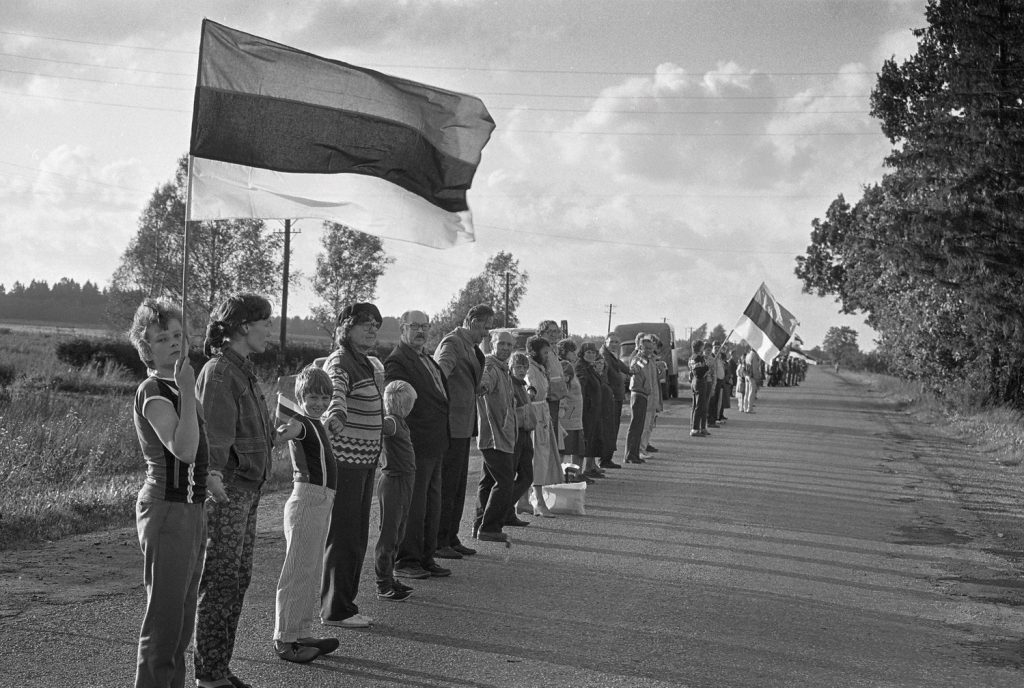
At around 7:00 PM local time on 23 August, 1989, an ambitious photojournalist finds himself in a helicopter flying over a major highway in Latvia. Peering out of the helicopter’s window with his camera in hand, he can hardly believe his eyes. On the ground below lies a massive human chain of demonstrators holding hands along the length of the road, whose ranks stretch as far as the horizon. The historic protest this photojournalist witnessed is a key moment in the history of Eastern Europe, and an important step towards dismantling the old social and political order imposed by the now weakening Soviet Union.
Known today as the three “Baltic states”, Estonia, Latvia, Lithuania were for much of their recent history, under the thumb of a larger, more powerful political entity. They were, after all, situated close to several major historical powers, including Sweden, Germany, and Russia. Still, these countries had long been adamant in preserving their national identities and cultures, even in the face of power opposition. In few other instances has this been more true than during late stages of the Baltic states’ membership in the Soviet Union.
On 23 August 1939, Nazi German leader Adolf Hitler and Soviet Union leader Josef Stalin came to an agreement known as the Molotov-Ribbentrop Pact. Under this agreement, the land lying between the two countries, which included Poland, the Baltic states, and others, would be divided into “spheres of influence” for both Germany and the Soviet Union. While Poland was split between the two rising superpowers, the Baltic states were left entirely to the Soviets. Using both military and political means to pressure them, Stalin essentially bullied the Baltic states into forming the Estonian, Latvian, and Lithuanian Soviet Socialist Republics. The process of Sovietization of the three nations included the deportation of tens of thousands of citizens which were deemed “hostile” by Soviet officials.
Fast forward fifty years from that fateful agreement and one finds a Baltic region weary of decades of Soviet control which, among other perceived violations of Baltic autonomy, included the purposeful introduction of Russian migrants (who influenced local policy in favor of the central Soviet authority in Moscow), and policies that suppressed the expression of the languages and cultures of the three Baltic nations. Meanwhile, the Soviet Union officially maintained the stance that all three nations voluntarily joined the USSR, instead of being forced to do so by Nazi or Soviet political maneuvering. Leading up to the 50th anniversary of the Pact, tensions and rhetoric surrounding reform or even independence in the Baltic states surged. These movements were condemned as harmful “nationalism” by Soviet authorities, as they prepared for a possible military crackdown on the region.
With the significance of the 50th anniversary in mind, local officials in all three nations began to plan one massive demonstration they hoped would capture the attention of the entire world. Though it is not clear who came up with the idea of a massive human chain, the concept was communicated to political and social organizations across Estonia, Latvia, and Lithuania, and a plan was approved. The chain would link Tallinn, Riga, and Vilnius, the three capitals of the Baltic nations. Organizers determined that in order for the plan to work, around 1,500,000 participants would be needed.
According to most estimates, the expected numbers were met, and perhaps even exceeded on that fateful Wednesday evening. Along the highways connecting the Baltic capitals, demonstrators held hands and sang national hymns. The flags of all three nations flew proudly in the wind, as reporters swarmed to capture the spectacle. Solidarity demonstrations were held in cities across the world, including Moscow (although police quickly dispersed that demonstration). Though the whole ordeal lasted little more than 15 minutes, up to two million participants were estimated to have taken part in this historic demonstration, which amounted to a quarter of the total population of the three Baltic nations.
The event was highly publicized in the media across the world, bringing international attention to the issue of Baltic independence. Though the demonstration was initially denounced by Soviet media, again claiming that the protests was little more than a manifestation of harmful nationslist rhetoric, it did cause Soviet leader Mikhail Gorbachev to reconsider the issue of Baltic independence. In December of 1989, mere months after the protest, an official condemnation of the secret protocols of the Molotov-Ribbentrop Pact was signed by Gorbachev. After free elections were held in the Soviet Union for the first time in 1990, pro-independence candidates in the Baltic countries were placed into public office. And finally, by the end of the following year, the Republic of Estonia, the Republic of Latvia, and Republic of Lithuania were established and internationally recognized as free and independent countries.
Today, the Baltic Way remains one of the largest peaceful demonstrations in history. It has been a source of inspiration for protestors in places such as Catalonia and Hong Kong, who have emulated the creation of a human chain. The independence movements of the Baltic nations contributed to the total collapse of the Soviet Union and its stranglehold on Eastern Europe. All three of the Baltic nations are now comfortably outside of the Russian sphere of influence, being members of both NATO and the EU. The Baltic countries are among the most developed and prosperous countries in the world.
 History for Empathy