
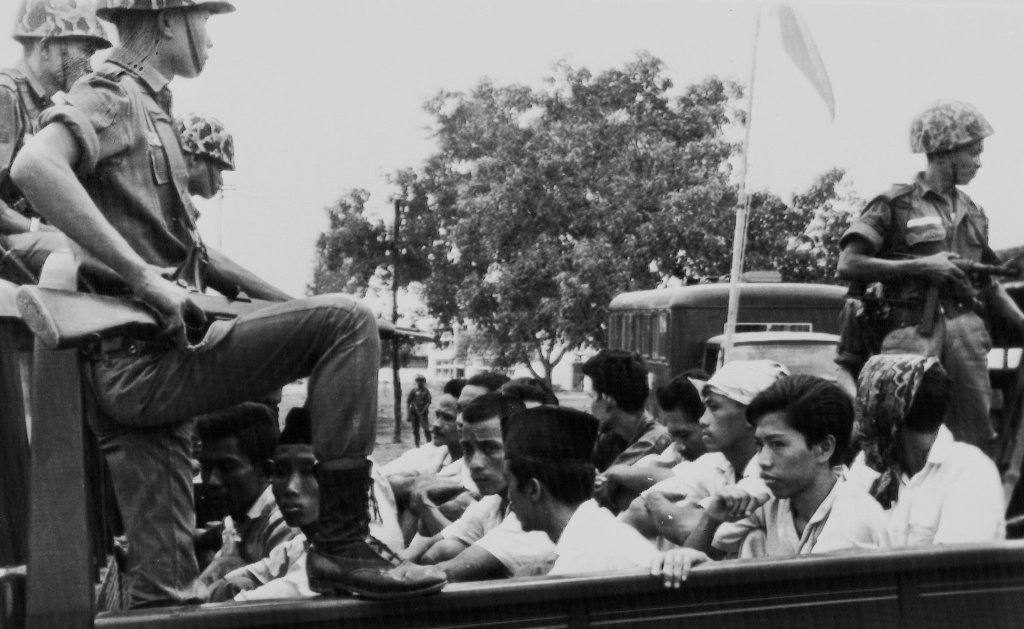
There were few parts of the world left unaffected by the global political and ideological struggles that occurred as a result of the Cold War. Countless nations faced both external and internal conflicts that–though often seen at the time as events solely relevant to the apparent parties–were really the result of larger machinations by the two global superpowers of the time, the United States and Soviet Union. Lives were lost, peoples were uprooted, and countries faced lasting damage to its social fabric, all in the name of power games played by those who were completely removed from the destruction they allowed and insulated by the consequences they created. In few other instances was this more true than the mass killings that took place in Indonesia in the 1960s, in which millions of suspected communists or opposition sympathizers, ethnic minorities, or even alleged religious apostates were systematically murdered by the Indonesian government. While much of the Indonesian leadership under prominent general Suharto are undeniably and hugely responsible for the atrocities that took place, the role of several Western countries who facilitated the killings due to political interests cannot be ignored.
Now the fourth largest country, in the world, Indonesia did not take its modern form until 1945. The nation’s many islands were under Dutch colonial control for well over three centuries, dating back to the lucrative spice trade that contributed to the Dutch Golden Age in the 1600s. Intense political pressure from the United States (who pushed a heavily anti-colonial agenda following WW2), as well as surging internal conflicts forced the hand of Dutch leadership, granting absolute sovereignty to the Indonesian people in 1949. However, even before receiving full international recognition, the government of Indonesia was already beginning to take form under Sukarno, a seasoned and idealistic statesman who played a major role in earlier independence movements. Sukarno would be Indonesia’s president for the next two decades, and his policies would be significant in setting the stage for the events to come. His most consequential plan was that of “Guided Democracy”, which, after being implemented in 1959, aimed to resolve the political tension that plagued the early days of Indonesia. Though Sukarno would assume near-dictatorial power, he promised that each of Indonesia’s three main factions: the nationalists, Islamists, and communists, would each have representation in his cabinet, similar to how the elder leadership Indonesian village would operate. The plan, however, failed. In the end, it was conflict between the factions that unraveled Sukarno’s Indonesia, with plenty of outside parties willing to take advantage of the chaos.
The first nail in the coffin for Sukarno came when he began an intense anti-Western political campaign, especially against the United States, which ensured that any sympathy he had from the Western bloc was now gone. Not long after Sukarno’s first denunciations of Western imperialism, a radical militant group executed six top Indonesian generals suspected of harboring pro-Western sympathies, with the impression that Sukarno himself would support them in stopping a potential coup. This incident is now known as the 30 September movement. Despite the movement’s hopes, Sukarno distanced himself from the attacks, leading many to wonder who was responsible. Suharto, the well-respected general who dispersed the militants from Jakarta’s central square, immediately blamed the PKI, by far the largest communist faction Indonesia and, with membership nearing four million, the third largest communist party in the world at the time. Nationalist, Islamic, and even Christian groups joined in blaming PKI, distributing propaganda that demonized the party. Sukarno, himself having Marxist sympathies and also wanting to keep the peace, discouraged any violence against PKI. However, with Suharto gaining influence over the army and other factions extremely quickly, Sukarno was powerless to stop the events that would soon unfold.
Beginning in 1965, with the military firmly under his personal control, Sukarno set about a brutal campaign that would claim the lives of more than one million people. The Indonesian Army, with the support of various local groups, captured and summarily executed suspected PKI sympathizers, as well as members of other factions that were deemed enemies of Indonesia. Besides the PKI itself, political groups with strong ties to the party, such as the Gerwani (The Indonesian Women’s Group), BTI (Indonesian Farmer’s Union), and even members of the PKI’s youth branch had their ranks decimated. Some ethnic populations, such as Chinese-Indonesians, were also targeted due to their suspected anti-Indonesian or pro-communist sentiments. In addition to political or ethnic groups, some units within the Indonesian military had PKI affiliations or connections to 30 September, making them targets for internal purges. It should be noted, however, that the mass killings in Indonesia from 1965 to 1966 did not constitute a civil war. Open combat between opposing factions was very rare, and the groups that carried out the violence were given complete political legitimacy.
Victims of the killings included women, children, and the elderly, all of whom met a variety of brutal ends. After being interrogated, tortured, bayoneted, clubbed, and/or shot, corpses were often left mutilated in the streets, or dumped into nearby caves or rivers. Though higher ranked PKI members or sympathizers almost always faced execution, up to 750,000 people were also imprisoned in long-term jails, some of whom were not released until the 1980s. In addition to the mass killings and detainments, damage to homes, farms, and other properties were common, leaving surviving victims with little to return to.
While Suharto’s vicious power grab is without a doubt the main reason behind the atrocities being committed, he himself was not the only one that could gain from the removal of the PKI and its supporters from Indonesia. The collapse of Sukarno’s government and the rise Suharto just so happened to occur during one of the most tense periods of the Cold War. The Western powers, particularly the United States and United Kingdom, had lots to gain if Indonesia’s massive communist supporter base were to be eliminated. Regarding the American role in the massacre, its interest in the matter was fairly obvious: an opportunity to destroy the PKI was an opportunity to ensure that Indonesia would be loyal to the United States, and hostile to the Soviet Union. Even before the walls started to cave in on his administration, the CIA sought to remove the communist-sympathetic Sukarno through a variety of means, even resorting to making a fake pornographic film that featured his likeness. But before long, Suharto was doing much of the CIA’s work (that is, killing communists) on its behalf, and American operatives were more than willing to assist in propaganda efforts that strengthened the general’s cause. The CIA provided Suharto with equipment that would aid in spreading anti-PKI sentiments among the Indonesian people, as well as hit lists that contained the names of thousands of PKI members. Meanwhile, US embassy officials offered to suppress internal media narratives about of Suharto’s massacres, in order to ensure that Suharto would be portrayed as butcher. While the US certainly played their part in facilitating the killings, they were not the only ones with a stake in the matter. The Indonesian government under Sukarno had long been in conflict with Malaysia, which at the time was a member of the British Commonwealth, and thus an valued ally to the UK. Like their American allies, British and Australian foreign officials used inflammatory propaganda to further the destruction of the Sukarno and the PKI.
In the end, Sukarno’s presidency collapsed completely, with Suharto seizing power 1967 and completely reorganizing the Indonesian government under his “New Order”. He would rule Indonesia for the next 31 years. The chief perpetrators of the mass killings were not punished, since Suharto and his top officials became the authority by which they should have punished. In 2016, an international human right’s court in The Hague ruled that the Indonesian government was guilty of crimes against humanity, while also calling out the United States, United Kingdom, and Australia as complicit in those crimes. The court in question had no actual legal authority over any of the parties in question, so those deemed responsible have yet to face any consequences. The Indonesian killings of the 1960s is both a cautionary tale to the corruption that a quest for power can create, and a call to action to make world leaders more responsible for their actions and aware of the grave consequences their decisions can have.
 History for Empathy