
Genocide, in both the public conscience and international law, is considered among the worst crimes an individual or state can be responsible for. It is a crime considered perhaps unmatched in its barbarity, destruction, and divergence from the idea of global peace and tolerance. In the eyes of some, however, there are genocides whose circumstances allow a certain level of justification, or even moral plausibility. While this article will continue to condemn genocide in any form and without regard for historical context, it will examine the origins of such sentiments, and explore how they can likewise be formed in crimes with absolutely no claim to morality, except in the eyes of its perpetrators.
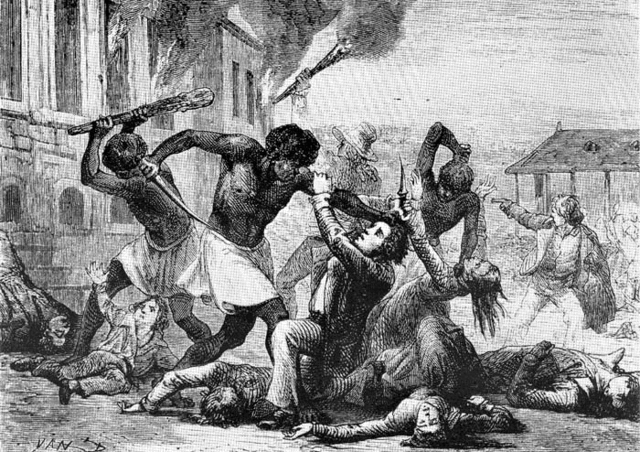
The Haitian Revolution, and the subsequent massacre of the nation’s white population in 1804, was an event that shocked the world, and is one example of a genocide that maintains some level of moral controversy, even more than two hundred years after the fact. Saint-Domingue, as the French colony in modern-day Haiti was then known, consisted almost entirely of sugar or coffee plantations that were owned by a small white French elite, and worked on by an African slave majority. The colony was among the most valuable in the world, producing nearly unrivaled amount wealth for the French, especially given its relatively small area. No different from their counterparts in other parts of the Americas (although work on sugar plantations were often more brutal than those producing other crops), slaves in Saint-Domingue were treated as little more than property, enduring inhumane and abusive conditions, typically leading to the death of a slave in a matter of years. In fact, by the dawn of the Haitian Revolution, the number of new slaves being imported into Saint-Domingue grew larger than its entire white population. By 1790, with only six percent of Saint-Domingue’s population being white, five percent being free people of color, and the rest slaves, it was only a matter of time before the resentment towards such a massive imbalance of power boiled over into full-scale revolution. Though the Haitian Revolution technically started as a dispute involving free people of color, lower class whites, and planters, the chaos caused by that conflict as well as the French Revolution sparked a massive slave revolt in 1791.
The Haitian Revolution developed first into a war for emancipation, then as a struggle over total control of the island between rival Haitian factions, and finally as a war for total independence from a now Napoleonic France. By 1804, this final goal was reached, and Jean-Jacques Dessalines, a prominent military leader of full African descent, was deemed Governor-General, and later Emperor of Haiti. Passionately recalling the countless acts of brutality committed by the white French plantation owners and military leaders both before and during the Revolution, Dessalines called for all whites remaining in Haiti to be put to be killed. Through the winter and spring of 1804, Haitian soldiers (often former slaves) under the personal supervision of Dessalines marched between Haiti’s cities and massacred up to 5,000 white civilians. By April, Dessalines’ goal of a complete removal of whites was met, with the only full whites remaining in the country being women married into black families. The events of 1804 made slaveowners in other parts of the Americas–especially in the American South, where many surviving Haitian planters fled to–concerned about a similar event happening on their own plantations. As these white American or European leaders condemned what they viewed as barbarity, Haitian leadership defended the massacre as a necessary act of justice and retribution, an idea which persisted long after the last bullet had been shot.
From C.L.R. James’ 1938 historical account of the Haitian Revolution, The Black Jacobins
“The massacre of the whites was a tragedy; not for the whites…. for these there is no need to waste one tear or one drop of ink.”
James and others sympathetic to Dessalines’ actions cite the generational cruelty inflicted by the whites on Saint-Domingue, the brutal, scorched earth tactics used by French forces during the Haitian Revolution, and the threat of counterrevolution, all as factors that ultimately justify the 1804 massacres. Regardless of what opinion they actually have, readers will certainly see how these factors are, to an extent, sufficient in justifying the actions of Dessalines and his men. What is more important, however, is recognizing how the core principles that justified in the 1804 Haiti Massacre are seen in instances of genocide whose evil and senselessness are seldom contested.
Let us now look at the most famous of genocides, the Holocaust, a crime which no reasonable person would ever defend as just or necessary. After WW1, Germany was left humiliated by its defeat, becoming as politically and economically weak as the relatively new nation had ever been. From a desire to restore German dignity and standing in the world, rose the Nazi party under Adolf Hitler, and the establishment of the Third Reich. Besides the unfair Versailles Treaty given to them by the Allied Powers of Britain, France, and others, Nazi ideology blamed various groups within German society for their failures. No group was blamed to a greater extent than Jews, whom the Nazis claimed sabotaged the efforts of Germany in favor of promoting their personal and political interests. This element of blame was key, since there was a sense that not only should the Jews be removed for the betterment of German society, but that the expulsion or extermination of Jews was a righteous act of justice and retribution for the crimes they had committed against the nation. So, despite clear evidence that no such Jewish conspiracy existed, and that German Jews had served as heroically in WW1 as their “Aryan” counterparts, the emotional satisfaction the Nazi ideology and plan of action offered to the German people was sufficient in allowing the Hitler and his party to take power.
In the case of the Haitian Massacres and the Holocaust, though different in many ways, the two seem to have in common one key idea: that they were justified by the perpetrators as an act of justice, rather than a crime. During the Haitian Massacres, Dessalines and his sympathizers justified the slaughter of thousands of civilians by reminding the people of Haiti the atrocities they had faced at the hands of the white planters. The Nazi propaganda machine made similar claims about the Jews: that the suffering and weakening of the Germans was to be blamed on the acts of sabotage and treachery done by Jews, or other groups which the Nazis wished to exterminate. In predicting and preventing future acts of genocide, the international community must watch for countries whose social conditions may generate a similar situation to that of Haiti or Nazi Germany; that is, countries in which a controlling group may be in a position to blame a potential victim group for certain wrongs, however justified that blame may be.
 History for Empathy